I realize my posts have been rather melancholic lately. It's probably because I stay up so late at night and let serious thoughts take up the space in my brain that should be reserved for dreaming.
So tonight, I'll share some random longings -- things I'd like to add to this season of my life.
First, when I left the office life a couple of years ago, I had two goals. I wanted to learn to play the fiddle and I wanted to learn to weld.
Both of those pursuits still interest me. I did buy a fiddle. The welding idea came about when I spent hours day-dreaming of turning the hood of a former boss's car into a coyote sculpture. (That was another signal that it might be time to work from home.)
Maybe I'll put feet on my thoughts and do something to make them realities. The artistic parts, not the vandalism parts.
I also want a hammered dulcimer to add to my collection of instruments.
I'd like to burn my candles all day and make my house smell like my favorite gift shop. And I'd like to play soft, inspiring music to help me relax.
I'd like to never see another mouse. Especially not in my house. I'm so serious about this I am considering building a house with steel framing and insulated concrete forms -- and learning to tolerate a cat. He'd have to earn his keep, though, because I am really a dog person.
Which reminds me... I wouldn't mind having a puppy. I had a much beloved dog for 15 years -- a stray poodle that was about 5 years old when she came into my life. Problem is, a puppy that lives that long most likely will outlive me, or see me start drawing Social Security.
Sounds like I need a vacation to Silver Dollar City... I haven't been since I was married. That wasn't a fun trip because of my ex's obsessive-compulsive disorder and his anxiety about taking a road trip. Maybe I'll treat myself next week. Good plan!
I'd like to live a life where a denim jumper was appropriate work attire and no one would look at you weird if you started singing Gospel songs out loud for no reason other than your soul needs to.
Here's a nice site to check out when you're having a bluesy day. It includes 36 sensible ideas for overcoming stress, from a Christian perspective. Nice background music, too.
http://www.wandascountryhome.com/raindrops/index.html
Thursday, September 30, 2004


Tuesday, September 28, 2004
Tonight is Harvest Moon
Tonight's the real night. It's the real full moon.
Make a plan, now, to get yourself and your sweetie outside to watch the moonrise. September's full moon is called the Harvest Moon because it is close to the Earth and provides so much light that farmers of yore were able to work in the fields throughout the night. This full moon will appear incredibly large and bright. Those who want to know more about the eliptical pattern of the moon's orbit can find plenty of astronomy web sites that go into detail. Yeah, all that's nice, but the magic is in being out in the dark, lit only by the lunar glow. It's a treasure best shared with someone special.
Moon rise in Oklahoma tonight will be about 7:45 p.m. Wait another couple of hours to see it rise above the eastern horizon-- if you catch it at the right time, it may glow gold before turning to silver.
Good songs to sing this evening: "Shine on Harvest Moon"; "By the Light of the Silvery Moon" and "Moonlight Bay."
The next full Moon on the calendar, after this month’s Harvest Moon, comes on the night of Oct. 27-28. There will be a bonus that night: A total eclipse of the Moon. Kind of turns the lights out on Hunters' Moon, doesn't it?
ENJOY!
Remembering Bob
The fall of the year is always nostalgic for me. There are so many family memories, especially on my dad's side.
Fall means harvest -- the last glorious products from grandma's garden. It means gathering together scattered relatives for the last visits before cold weather grounded everyone.
Fall also marked the start of the school year. When I was little, school didn't start until Tuesday after Labor Day, unlike today when my teacher friends are back in their classrooms when August has barely started. I think that was a much more civilized approach to education -- who can concentrate in the blistering heat?
Most of all, the changing of the leaves and the crunching of dying grass reminds me of my brother Bob. Each October my soul is flooded with memories from October 1962.
We had a ritual of raking the leaves together, and the sounds and smells are forever imprinted in my memory. There's a photograph of him next to a pile of leaves, wearing a scarf and beret for his part as a Frenchman in a school play.
That same fall, our grandparents celebrated their 50th wedding anniversary. Grandma was 15 when they got married; Grandpa was 16.
Even though the grownups were all busy getting ready for the celebration, Grandpa made the time to play his banjo for us and then gave us a pumpkin from his garden to make a jack-o'lantern.
Days before Halloween we were home, playing tag and telling ghost stories. Bob picked up the pumpkin as he chased me around the house, making up a tale of some headless monster.
About the third time around the living room, he tripped, and our cherished pumpkin went flying, landing in a shattered mess on the floor. It was like losing a member of the family.
"I'm sorry, Mr. Pumpkin!" Bob exclaimed.
That bittersweet phrase has been repeated nearly every fall since. I miss hearing it as much as I miss Bob and Mr. Pumpkin.
Despite that sad Halloween episode, many autumnal events brought joy to Bob's life: pumpkin pie and cranberry sauce at Thanksgiving, followed by our ritual of decorating the Christmas tree on his birthday on Dec. 12. He loved flowers, too, and managed to grow amaryllises so he nearly always had a bloom open on his birthday.
Bob died in his sleep on Nov. 17, 1997. He was 43.
I last saw him the day after Halloween that year, and remembered that particular autumn in our childhood, now more than four decades ago.
He loved Paul Harvey, Lawrence Welk, public television and listening to country gospel records. He filled his days listening to the police scanner for the town gossip, figuring out how things work and playing with his beagle, Tippy.
Bob never worked; his job in life simply was to be who he was, and he did it well. These days the politically correct term is "special needs;" in our childhood, less kind terms were applied to his condition. It's best that those words stay in the past.
We were blessed to have grown up in a small Oklahoma town. Bob had the chance to be at home there, which wouldn't have been possible in a larger city. People knew Bob, and were patient with him. They listened to him even when it was hard to understand him. And that's all that really mattered to him, because he liked to talk.
But the blessing also had another side. Education and training opportunities for Bob and his peers were severely limited in our hometown in the 1960s. Bob attended special school until he was 12; from that age on, he was at home, under our mother's care. There was no need for assisted living, or group homes, or institutionalization in our family. We were lucky that it was possible for Bob and Mom to live together and take care of each other.
He was fascinated with power tools and electricity, and his week was not complete without several hours of how-to programs on public television. Employees in all the hardware stores in town knew Bob and his latest project.
He finished few, but finishing was never the point to any of Bob's projects. One work he did complete has a permanent home in my kitchen - a simple wooden stepstool he made so I could reach my cabinets. I use it every day.
Yes, Bob's main job was simply to be who he was. He needed no day planner; scheduling wasn't important. There was no rat race, no corporate ladder that needed climbing. He lived on God's timetable.
His needs were simple - eating a grilled cheese sandwich, visiting with his bingo buddies, studying the displays at the hardware store, playing the piano by ear.
But he had goals, and worked toward those until he achieved them. Most of them were goals he had for helping someone else, including me. I learned how to rewire lamps by watching him.
Christmas was the big day of the year for him, because that was when he could give his presents. It was impossible for him to keep a secret, though, so we always knew what was under the tree before we unwrapped our packages.
Bob didn't understand much about religion or theology, but he knew the Christmas story, and he believed in angels and heaven. Before it became physically difficult for him to attend, he enjoyed going to church, especially to hear the music and to visit with his friends.
He prayed for people instinctively. I think that's why he loved gospel music so much; the messages in the music were already rooted in who he was.
The day Bob died, Mom tried to wake him so he wouldn't miss hearing Paul Harvey on the radio, but the angels had already visited in the night to tell him "the rest of the story".
It seemed right, somehow, that many of his bingo buddies heard the news on the police scanner.
I miss you, Bob, and there will be a special pumpkin on the porch for you this Halloween.
Sunday, September 26, 2004
The Scarecrows' Hoedown
That's the subtitle I am giving to tonight's Harvest Moon party, taking place in my backyard in less than 4 hours.
There's a new grill waiting for its first firing. The firepit still needs to be screwed together. I gave up on figuring out the new smoker last night after it got dark, so I have two briskets getting all happy-like in my oven. Yum!
The hot dogs are cozy in the refrigerator, next to the ground beef for burgers. There should be enough pop to float a boat.
Yep, there's stuff for s'mores -- I got a "little extra" just because I love chocolate and I'm hoping for a smidge of leftovers.
Yesterday I mowed the yard, trimmed the overgrown shrubs along the patio fence, scraped up six years of leaf mold that has composted along the pathway. I have approximately 93 mosquito bites from the effort.
It's time to put up the tiki torches filled with citronella oil, pull out all the folding chairs and start decorating the table. I'll need to get all the veggies cut up to put on the grill or to put out for fancy-ing up the burgers.
Moon rise is about 6:45 tonight. I can't wait!
The scarecrows? Well, there are six of them sitting around my living room in various states of construction. That's my "shoulda" project for the week -- as in "shoulda gotten 'em finished before now." Eh, I've got more time. They aren't going anywhere without me.
Thursday, September 23, 2004
Aftermath
The past few days have given me a different perspective. It's the first time in my life I've been approached by other reporters for information.
My help is only marginal. I can share the name of some of Jack's friends, and I wrote a brief "classmate of the victim" kind of comment for a reporter from a town close to our hometown, a little place just across the Kansas border.
I let her know I considered it very optional since there were so many people who knew him well. She's kindly offered to send me a copy of her story after it runs.
Jack deserves to have his story known. We all do.
Wednesday, September 22, 2004
What Do We Learn From This?
Tonight at my Bible study, a fellow student made a comment that was far more profound than she could possible have known.
Loosely paraphrased, she said we most need to forgive those who most torment us, because that person will be our roommate in heaven.
When she made this statement, she had no idea that I had gone to school with Jack Hensley. I had planned to lift him up in our prayer time, but we had not taken prayer requests yet.
It was a God moment -- my ears were open and His voice spoke to me. Yes! We must, somehow, find a way to forgive even the most cruel, most ghastly, most horrifying person.
But why? some may ask.
We must, because Christ came to Earth and submitted Himself to be crucified to save even that person.
Who needs redemption and restoration more than the worst of the worst? Who has moved so far away from a whole relationship with the Creator than those who would dare to destroy the Creation?
I think that loving the loveable is not so tough. It's not for us humans, so certainly it's not a challenge for God. But you know what? He loves the human monsters as well. It is for them, as well as for us, that He sent the Son.
Tonight we talked about parts of Genesis. When Eve (and Adam) ate of the Fruit, they knew they were naked. What did that represent? Far more than just showing a little skin and naughty bits. This was the moment when humans first understood being fearful and vulnerable. They hid from God because of the fear that had entered their lives.
And yet, God sought them out. He looked for them in the garden because He loved them.
He knew why they hid. Their act of disobedience had the natural consequences of fracturing the open, beautiful, loving and safe relationship God had enjoyed walking in the garden with them.
It is so hard to try to think in terms of forgiving those who behead people who have been on a mission of mercy. It's darn near impossible. But if I know that MY sins are forgiven, I have to believe that anyone who asks God for redemption will also be forgiven.
Now, I don't know if these monsters will, one day, understand their sin and repent of it, asking for God's forgiveness. It's not my responsibility to forecast that or to question their sincerity if they do repent.
What I do know is that heaven is going to hold a LOT of surprises when we get there. We better make room for some unexpected roommates.
Tuesday, September 21, 2004
Breaking news
AP is reporting a second hostage has been beheaded in Iraq. It is saying the identity is not yet confirmed. However, MSNBC is reporting it is Jack Hensley.
May God bless the soul of the victim, whether it is Jack or the Briton. And God bless the remaining captive. May He bring comfort to the families.
May God bless the soul of the victim, whether it is Jack or the Briton. And God bless the remaining captive. May He bring comfort to the families.
Two Degrees to Terror
April 19, 1995. Oklahoma City's Alfred P. Murrah Federal Building bombed.
May 3, 1999. Oklahoma City's deadly tornado, the biggest tornado ever recorded.
September 11, 2001. Foreign terrorists attack the United States.
Many people remember these days and the pain they bear.
September 21, 2004 -- today -- may join the list of days we want to expunge.
The probability is great that the militant group led by al-Qaida ally Abu Musab al-Zarqawi's Tawhid and Jihad group will behead American Jack Hensley later today. The video of the beheading of Eugene Armstrong is being shown on the internet. It is nothing I am interested in seeing; I can barely stand to read about it.
These aren't just historic dates and events on my calendar. I can't simply sit back, shake my head and say "What a shame. Those poor people." In 20 years, I won't be able to play the game "Where Were You When...?"
In all of these horrendous moments, I am a captive in another game: "Two Degrees to Terror."
It's a nightmarish version of the game "Six Degrees to Kevin Bacon."
Perhaps you've played the game -- you know someone who knows someone who...
Each of these days is a punch in the stomach to me. They wound me in a personal way.
No, I haven't been a direct victim of the bombing, the tornado, the plane attacks or the beheading of an American in Iraq. People I know personally have been.
In the "Two Degrees" game, I've recently written about co-workers who were wounded in the bombing or whose psyche was wounded by covering the event.
Some of our co-workers lost homes, cars and other possessions in the May 3, 1999, tornado. The rest of us rallied around them as well as we could trying to set their lives right again.
Another co-worker gave his personal account of being in Washington, D.C., on Sept. 11. I've given my account of waiting for him to return to work.
Now comes midnight, Sept. 21, 2004. I wait and worry about Jack Handley and his family.
So now, the Second Degree in this latest round of the game.
Jack and I went to high school together. I knew the name when I first heard about the captives, but I couldn't quite place why it sounded familiar.
Within 10 minutes I got an e-mail from a friend I've known since high school. Jack had been his friend since grade school.
I pulled out my yearbooks and recognized Jack's pictures, vaguely. We were in a large class so I wasn't close to him, but I did know the face. We never had a class together. I may have seen him at class reunions without knowing it. He and his wife and children have only recently left our hometown to move to Georgia.
Today I received an e-mail and phone calls from a bureau reporter who was working on background in the event of the most horrible outcome.
As it happens, my longtime friend who had been friends with Jack is in town and we'll have dinner tonight. My friend is now a minister who is in town for a church meeting. I'll put him in touch with the reporter. Everyone deserves to be remembered for the greatest moments of their lives. Their stories should be told and remembered.
This is what journalists and eulogists have in common. They are the story tellers that connect the past with the future.
I just hate being involved in the process of connecting the story tellers. And I could do without any more Two-Degree stories.
The game makes us realize that at any moment, any event could include any one of us.
I pray and pray for the miracle that could spare Jack's life and the life of Briton Kenneth Bigley.
I pray more for God's goodness to heal a world that is in such pain that it's driven to wars and terrorist acts.
Monday, September 20, 2004
People are interesting ...
Except when they aren't.
CAUTION: You are entering a momentary rant. This is a temporary situation that will work itself out with a little bit of time and effort. But for the moment, I must vent to you, my friends who are mostly total strangers.
This is about the hazards of new relationships. I'm not good at relationships. Never have been, my history would show. But I've recently started up with someone new, and doggone it, this one is a mere human being too. It was hard to see that at first with that bright initial glowing.
You may know what I mean. Maybe you've met someone and the newness seems so refreshing. This new person brings a perspective you haven't seen before; he is on his best behavior, and you are on yours.
Then you realize you've fallen under the spell again -- you've been looking at only the good things and fantasizing that every day will be as phenomenal as the first couple of weeks. You know this is true, but you haven't started seeing the unpolished side yet. This is the stage where there's some reality setting in. Any day now you'll see the crack in the veneer.
It's week 3 now. Weekend 2 was phenomenal; on Monday morning the sun rises with birds singing.
But somewhere inside you, after you meet to have lunch together, you hear the crack. By the end of the day, your nerves are jangled. It only took one comment -- one time being told "you don't understand anything about xyz."
One unintentional slight. One instant of feeling put down.
The message you hear is "you're only a girl. You can't understand business and such."
OK, I am an adult woman. I have areas of expertise. I had a history and a professional background and an education a month ago. It didn't go away when we met. So far, you don't know my capabilities.
Yes, it is true. I can sit at your computer and reset your home page. I can load a pop-up blocker so you can get your work done. I can set filters to keep the porn out of your e-mail basket.
No, I don't know why the neighborhood teen-ager charged you $300 and you're still getting 300 Viagra ads in your inbox every day. Maybe you shouldn't have paid him before he sat down. Maybe you should have checked to make sure he was blocking subject lines instead of contact names.
Honestly, I am sorry it didn't work. And I am sorry that your ex didn't know that such things are computer-generated spam. And I'm sorry she accused you of being a perv who solicited all that type of mail. I know that virtually everyone with a computer and e-mail gets that kind of crap sent to them. I'm sorry she didn't know that. And I'm sorry she didn't trust you.
None of that stuff matters to me. But I could fix it for you.
It's a shame you don't think I can, just because I'm a girl.
There are a lot of things I could help you with. I could help you with a computerized inventory program so you don't have to do all that by hand. I could show you how to use a scanner for checking in inventory and generating sales reports. Yep, I sure could.
You are, indeed, the expert on managing your business. You built it and it is a good business. I'm proud of you and I hope you are proud of yourself. I know the day will come when you're more comfortable with technology that could help you.
I'll know we're on solid ground when you trust me to make a recommendation.
We'll be golden when you know that being a girl isn't a handicap.
We'll be plantinum when I can learn that I don't have to take offense at small, meaningless comments from someone I've only known a month.
We didn't start by exchanging resumes. In time, you'll see what a powerhouse I can be. This isn't a job interview. It's a relationship.
Monday, September 13, 2004
Meanwhile, back at the office
Several of you have been following the saga of Erudite Redneck (http://eruditeredneck.blogspot.com/) as he first traveled to Washington, D.C., in September 2001, then found himself in the midst of chaos and hell after the attacks of 9/11. He's shared the story of attending an insurance industry conference which included plans for a presentation on disasters by FEMA -- a presentation interrupted by terror.
His escape from D.C. involved depending on strangers, family members, a bottle of whiskey and earnest prayer. What he didn't know, at least at the time, was how earnestly people from the office were lifting up their own prayers for his return as well as feeling frustratingly helpless to get him home.
I was new to the department -- I had transferred in less than three weeks before the world turned upside down. I hadn't really had enough time to get comfortable with my job and a new work environment. Where I had had my own cubicle upstairs, I was now seated in a far corner of the newsroom, facing a dull, gray wall which was constantly assaulted by a bouncing ball thrown by the sports editor, approximately 25.5 inches from my throbbing head. More than once I was tempted to hurdle the desk and choke the life out of him.
It was a cultural shock coming from my previous department. One of the rare bright spots was getting to know E.R., an enigma if there ever was one. Here was a serious-minded, intense young man whose focus drilled right through his work (this is the erudite side). On the redneck side, his desk decor included a stuffed chicken, up to 10 nasty coffee cups growing an assortment of molds and an assortment of spit cups. Newspapers were stacked up two feet tall or more.
I know I threw him for a loop when I had to have my desktop lowered (I'm more than a foot shorter than he and couldn't work with my desk at shoulder height.) The big problem was that I wouldn't let him cross the border between his desk and mine with his mountains of materials.
We were still working through the "getting to know you" stage when he left for the D.C. trip. I enjoyed reading his columns and stories that I edited every week, and listening to him was a hoot without compare. But I didn't know him all that well yet.
The morning of 9/11, I woke up to my clock radio blaring the breaking news about the first plane hitting the first tower. It didn't make sense to me yet -- I couldn't tell if this was a real news report or some sick script written by the "wacky morning crew". I snapped on the TV where I was assaulted by the visual images. Like so many across the country, I thought a horrible accident had taken place -- until I saw the second plane hit the second tower.
After having seen what happened on April 19, 1995, I wasn't surprised when the towers fell. I've seen other buildings that were imploded on purpose, so I was waiting for the clouds of dust as all the other horrors were showing on the screen. From my room, I was urging people to RUN and keep running, to escape the fall of debris.
I got myself together in record time and headed for the office, wondering how in the world we as a staff were going to handle this news. For several hours there was chaos on the newsroom TVs -- how many planes had crashed? How many were still missing? Was the one that crashed in Pennsylvania really the plane that was heading for California, or was there another one still in the air heading for another target in the Washington? How badly was the Pentagon damaged?
How many people died in the attacks? Who?
I'm not even sure now how we got the messages telling about E.R.'s pilgrimage. My thought is that She Who Is His Wife forwarded his e-mails to our boss, or called him. He then told us what E.R. was going through. I don't really believe he had the inclination or thought to e-mail the boss himself.
There's no reason for him to think we expected him to "work" the story. We just wanted him to get the hell out of there and get back home. We knew that being so close to one of the targets was enough, too much, to endure. Working through that would be a ridiculous expectation.
Many of our co-workers had been at Ground Zero at the Alfred P. Murrah Federal Building on April 19, 1995. The woman who is now the department boss was there. She was at a post office caddy-corner from the building, getting a passport for her infant son. The ceiling fell in on her and the world went dark, she described. Somehow, in some way I don't understand today, she was in the office that afternoon, standing next to me as I watched the FBI storm the farm owned by Terry Nichols' brother. It was surreal with her standing next to me, her shoes filled with blood and glass, as the farmhouse doors were rammed. She was hurt, and the FBI was going after the bastards responsible for it.
Others from the office were in another courthouse building across the street, covering a trial. A staff artist had just taken his tiny sons to the YMCA day care center and was just pulling away when the bomb blasted. He told us he did a U-turn in the street to get back to the boys; a local TV crew filmed him carrying bloodied children to his truck so he could get them to the hospital.
Later in the morning, a photographer and reporter were on site doing their jobs when a gas line under the street exploded beneath them. They continued their work despite being shaken.
The point is, on our turf the staff did the job they were born to do. They did it at their personal peril and at the cost of being scarred forever by the things they witnessed. Never before had any newspaper staff in the country had to deal with a case of domestic terrorism.
To their immense credit, management did everything humanly possible to take care of the staff through the long months this story remained our reason for being. Food was brought in two or three times a day, every day for a month. Grace was extended whenever it was needed by those who reached their limits to cope. Psychologists were brought into the office and made available to anyone who wanted to talk.
We prayed that we'd never have to go through another experience like that. But it created a solid fraternity among all the departments of the newsroom. We weren't going to let any stinkin' cowards do any more damage to our people.
And so, when we got word of E.R.'s intense effort to get home, it was unbearable. We knew something of the pain, although 9/11 was a magnitude far beyond April 19. We couldn't imagine being spittin' distance from the Pentagon, of all places. He was there, and he was without us. We couldn't comfort him, couldn't protect him, couldn't get him home.
My helplessness was made more intense because in those few moments when the planes crashed, my new job virtually evaporated for weeks. My main job in this new department was to gather all the wire copy about national economic and business news.
Now there was NO economic or business news. All trading was suspended. The center of stock trading and America's economic center was out of business. Phone lines were destroyed, cell phone towers destroyed. Nothing in the world made sense for a good long time.
Our business section shrank by two thirds. Instead of a separate section, we wound up with one or two pages for local business news, maybe. I didn't have anything to do until the New York Stock Exchange reopened to trading. All I could do was read the news wires to try to understand what was happening, and fret.
Everything about E.R.'s journey home was filled with chance. Would he meet up with the friend? Would he be in the right place to connect with his sister-in-law? Would he really be able to get a rental car in Kentucky or would car lots be shut down like everything else?
Worse, would there be more attacks? What targets?
He made it home. He gave us cursory stories about what he'd gone through, but was too spent to tell us everything then.
For a little while, I didn't nag him about the nasty cups, at least not as much. And I think a stack or two did tilt over on my side of the border.
I was just glad he made it back. I'm glad he finally could tell his story. And I hope he knows that he's earned his place in the fraternity.
We're not accepting new members at this time. You hear that, bastards?
Thursday, September 09, 2004
Vivid dreams
It doesn't take someone skilled in dream analysis to explain the nightmare that woke me this morning.
The scene was far northwest Oklahoma City, a few years ago, before developers started building new subdivisions out that direction. At the time there was a small feed store near Portland (State Highway 74) and Edmond Road. It was an old place, reminiscent of a 1940s family grocery store. The roof ridge was adorned with the old saddles of once-loved horses who had gone to the big ranch in the sky. Colorful grain signs decorated the sides and advertised the wares within.
In the dream, chaos overtook this bucolic setting. Where horsemen's boots normally crunched across the gravel parking lot, emergency workers were trying to contain spilled diesel fuel.
The late afternoon sky was filled with smoke and the sound of endless sirens.
The roof of the feed store, once a testament to a rural lifestyle, now was pierced by the cockpit of a passenger jet. The plane was snapped at an angle; the front part pushing through the building and resting on the ground, the tail still high in the air, showing the angle at which the plane hit the building.
The point that puzzled me, even in my sleep, was the lack of people around the scene. Of course all those in the plane had been killed, as had anyone who had been on the ground. But in the aftermath, the only people present were a cleanup crew of about a dozen men, a couple of nearby property owners who just happened to be passing by, and a photographer from the newspaper, who was parked on Portland right in front of me. The photographer, Doug, and I have known each other since college days.
There were no other spectators, no television news crews, no helicopters or police.
The cleanup crew seemed to include firemen and oilfield experts. One burly guy used a giant grader to build a berm to contain the jet fuel while others brought in hoses to siphon it off. A few bulldozers were along the periphery, ready to remove contaminated soil.
I remember standing on the roadway, leaning against the hood of my car, watching Doug shoot a few photos. I was surprised at his casual approach -- he was staying at his car rather than moving closer to the action, which is not like any of the news photographers I know. It was as if he were shooting snapshots for a personal photo album.
The grader moved off to the west side of the scene as the team moved in closer with hoses and other equipment. A man with a bullhorn was narrating the action and directing the work. The workers moved almost mechanically, like they did this every day.
Just as they moved in, under the belly of the elevated part of the plane, the narrator's voice came over the bullhorn and calmly said "Gentlemen, an explosion is imminent. The fuel line has ignited."
At that statement, all the men in fire suits formed a tighter mass, futilely trying to put foam where the fuel had sparked. With the whole crew now in one small area, an electric blue fireball engulfed an area covering several acres.
A blinding white mushroom cloud followed the initial blast, filling the blue and purple sky. In a matter of moments the sky returned to its usual appearance, but nothing else was as it had been.
Now, the earth was barren and cratered. There was no evidence of anything that had been there two minutes earlier. There was no fire, no smoke. No building, no plane.
No people.
Even Doug was gone, as was his car.
The few land owners who saw what happened ran to the dusty brown crater to search for the wounded and dead. It was a pointless search as everything simply evaporated.
I noticed a figure moving west of the crash site -- it was the grader operator. I ran across the highway to see if he was injured. Physically he was fine, but he fell to the ground, sobbing. I joined him.
There was nothing more we could do; the alarm clock was playing Alan Jackson's "Where Were You When the Earth Stopped Turning?"
Saturday, September 04, 2004
From the arts festival
There's so much to see and enjoy at Arts Festival Oklahoma at Oklahoma City Community College. I talked to several of the artists and was surprised to learn that for most of them, their art was a second career. For decades they had worked at other jobs before taking up their various media. Most have only been artists for a few years -- most for less than six years. If they had worked previously in art, they learned a new medium that brought them a sense of renewal and new energy. Many were more than willing to offer to teach others.
The festival continues through Monday at Oklahoma City Community College, Interstate 44 and SW 74 (or Interstate 240 and May Avenue.) Parking is $3 and there are several drink and food wagons of the festival type. Another great thing about this festival is that the sponsors have not imposed the ridiculous "no outside food or drink" rule. Prices are reasonable ($5 for a chopped brisket sandwich, for example) but no one will stop you from bringing your own (non-alcoholic) drink. Many people came with their children in strollers, and many dogs attended, on leashes.
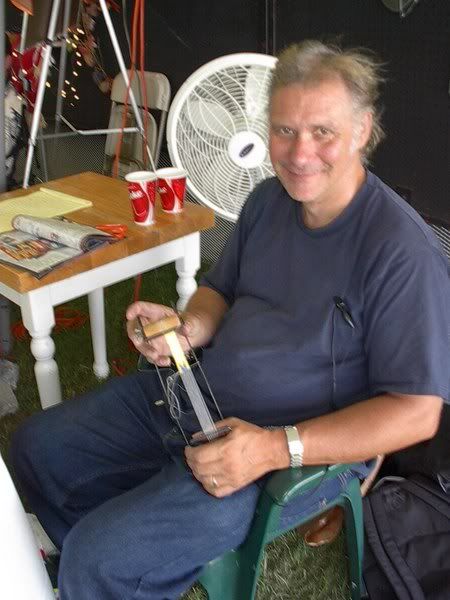 Hand beading on a small loom. This man was working in a booth operated by Bill English, a stained glass artist from Edmond with a studio called Glass In Stone. English said he hopes to teach in his studio sometime after Christmas. (405) 473-6047.
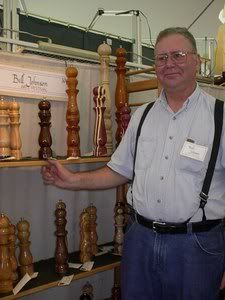 Bill Johnson of Sylvan Croft Woodworks, 7900 E Rock Creek Road, Norman, shows some of the handcrafted salt shakers and pepper mills he has made. Johnson uses several types of exotic wood. The purple and white mills are made with purpleheart, a very hard wood from South America. When Johnson retired six years ago, he had never used a lathe. (405) 329-6668; sylvancroftwoodworks.com
 The Laughing Rabbit Soap Company is one of several niche companies in the Choctaw, OK, area working with herbs and other botanicals. They make their soaps in 20-lb. batches to maintain quality. Since the soap retains so much of the glycerin created in the soapmaking process, it is a very moisturizing soap. The company also has bath accessories and aromatherapy products. The owners teach soapmaking classes through a local community program. (405) 737-7413 12732 SE 38th Street, Choctaw, OK 73020 www.lrsoaps.com
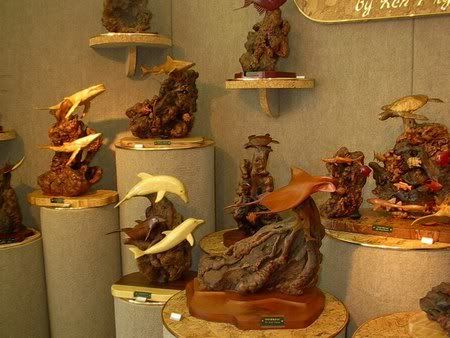
Sea Sculptures by Ken Pryor are made from exotic hardwoods. (405) 682-5698.
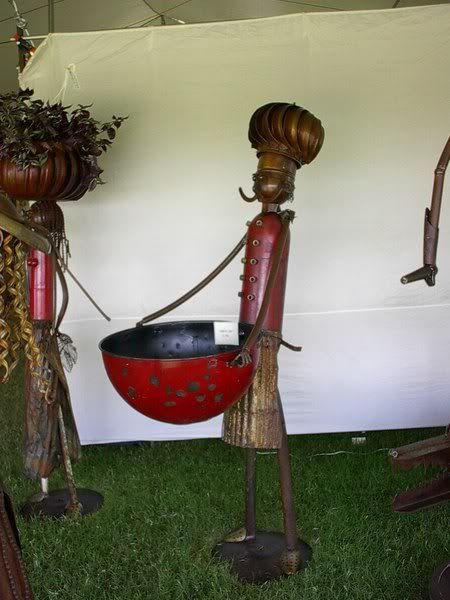
Kettle man does the Labor Day cooking.
Extreme whimsy sums up the metal art of Freeman Loughridge of Funksculp, "Sublimely Ridiculous Stuff." Loughridge, of Ardmore, collects unique pieces of aged metal to combine into art pieces with personality. Loughridge said he'll seek out individual pieces that aren't necessarily useful to anyone else -- he'll take stray claw feet from old bathtubs but will leave complete sets of four for people who may want to restore an old tub. Among his pieces are "Victoria," an unusual metallic portrait; "Cranking Out the Offspring," and "Getting Ready to Hang 10," both of which are a tongue-in-cheek look at the traditional roles of women. P.O. Box 603, Ardmore, OK 73402 (580) 504-5058 www. funksculp.com
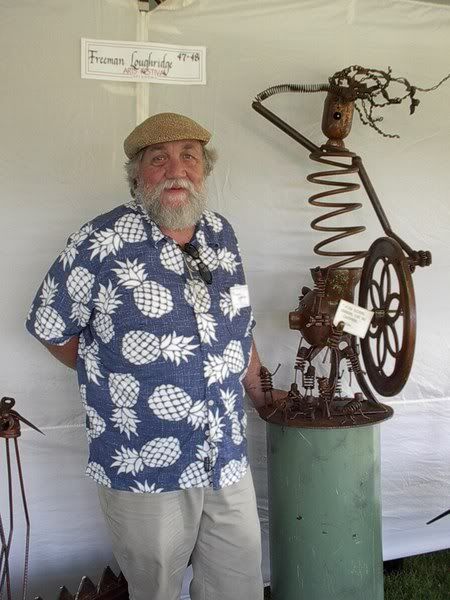
The artist with "Cranking Out the Offspring." The piece combines an old coffee grinder with an assortment of springs.
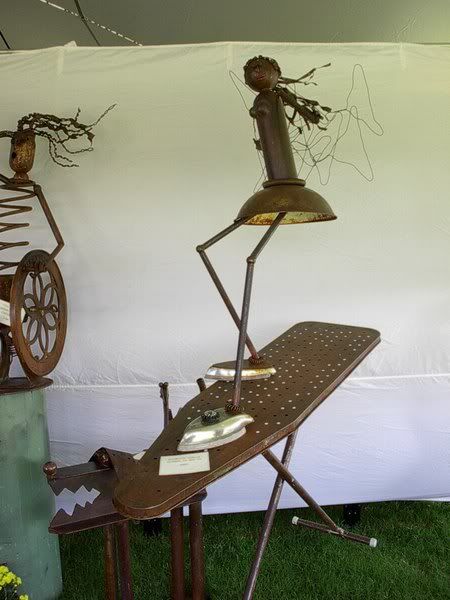
"Getting Ready to Hang 10" -- count the hangers streaming behind the woman's figure.

Warm, rustic colors create beautiful place settings in pottery created by Bentley Pottery. The collection also includes serving and cooking pieces as well as gardening pots. Dustin Bentley, Route 1, Box 98, Goodwell, OK 73939 (580) 349-3250.

Former art teacher Jim Miller and his wife, Judith, use a three-step firing process to add a thin band of gold to their earthenware pieces. They also use small three-dimensional pieces in their painting and create designer jewelry. Miller said he was a potter for 30 years before adding other techniques to his work. Blue House Pottery, 205 17th Ave. South, Clear Lake, Iowa 50428 (641) 357-3490
www.bluehousepottery.com
The festival continues through Monday at Oklahoma City Community College, Interstate 44 and SW 74 (or Interstate 240 and May Avenue.) Parking is $3 and there are several drink and food wagons of the festival type. Another great thing about this festival is that the sponsors have not imposed the ridiculous "no outside food or drink" rule. Prices are reasonable ($5 for a chopped brisket sandwich, for example) but no one will stop you from bringing your own (non-alcoholic) drink. Many people came with their children in strollers, and many dogs attended, on leashes.
Hand beading on a small loom. This man was working in a booth operated by Bill English, a stained glass artist from Edmond with a studio called Glass In Stone. English said he hopes to teach in his studio sometime after Christmas. (405) 473-6047.
Bill Johnson of Sylvan Croft Woodworks, 7900 E Rock Creek Road, Norman, shows some of the handcrafted salt shakers and pepper mills he has made. Johnson uses several types of exotic wood. The purple and white mills are made with purpleheart, a very hard wood from South America. When Johnson retired six years ago, he had never used a lathe. (405) 329-6668; sylvancroftwoodworks.com
The Laughing Rabbit Soap Company is one of several niche companies in the Choctaw, OK, area working with herbs and other botanicals. They make their soaps in 20-lb. batches to maintain quality. Since the soap retains so much of the glycerin created in the soapmaking process, it is a very moisturizing soap. The company also has bath accessories and aromatherapy products. The owners teach soapmaking classes through a local community program. (405) 737-7413 12732 SE 38th Street, Choctaw, OK 73020 www.lrsoaps.com
Sea Sculptures by Ken Pryor are made from exotic hardwoods. (405) 682-5698.
Kettle man does the Labor Day cooking.
Extreme whimsy sums up the metal art of Freeman Loughridge of Funksculp, "Sublimely Ridiculous Stuff." Loughridge, of Ardmore, collects unique pieces of aged metal to combine into art pieces with personality. Loughridge said he'll seek out individual pieces that aren't necessarily useful to anyone else -- he'll take stray claw feet from old bathtubs but will leave complete sets of four for people who may want to restore an old tub. Among his pieces are "Victoria," an unusual metallic portrait; "Cranking Out the Offspring," and "Getting Ready to Hang 10," both of which are a tongue-in-cheek look at the traditional roles of women. P.O. Box 603, Ardmore, OK 73402 (580) 504-5058 www. funksculp.com
The artist with "Cranking Out the Offspring." The piece combines an old coffee grinder with an assortment of springs.
"Getting Ready to Hang 10" -- count the hangers streaming behind the woman's figure.
Warm, rustic colors create beautiful place settings in pottery created by Bentley Pottery. The collection also includes serving and cooking pieces as well as gardening pots. Dustin Bentley, Route 1, Box 98, Goodwell, OK 73939 (580) 349-3250.
Former art teacher Jim Miller and his wife, Judith, use a three-step firing process to add a thin band of gold to their earthenware pieces. They also use small three-dimensional pieces in their painting and create designer jewelry. Miller said he was a potter for 30 years before adding other techniques to his work. Blue House Pottery, 205 17th Ave. South, Clear Lake, Iowa 50428 (641) 357-3490
www.bluehousepottery.com
It's Saturday! Time for FUN!
It may sound strange for those who know me, but Saturday is still a special day. I don't keep a conventional schedule -- no Monday-through-Friday work week, exactly. But even without that conventional measure of time, Saturdays remain a respite from the normal routine.
Today is a bonus, since it's part of the three-day Labor Day weekend. Not only will there be an extra day of leisure on Monday, but The Powers That Be have created once-a-year activities that I look forward to with great anticipation. I love celebrations, especially those that bring large groups of happy strangers to the same place at the same time.
Today it is the Arts Festival at Oklahoma City Community College. This has grown into a great event that's taking on an international flavor. The music is always great -- this year Brasil Brazil performed one of the nightly concerts. The Oklahoma City Philharmonic also will perform. And since it's Oklahoma, we have to have a great country act. This year it's Ty England.
More than 250 artists participate in a juried art show; it's among the best of the best that festival lovers will see. All kinds of visual arts will be represented and the artists make it accessible to just about everyone, even children, who get to shop among works donated by each of the artists. Kids' prices are practically give-away.
What festival could exist without food? Right, none. I mean, after all, doesn't "festival" mean "walking around with food?" I can't wait to see this year's offerings.
The amazing thing about this festival is the price. It's FREE. Parking costs $3 a car.
I'll pace myself. After all, the Great State Fair of Oklahoma opens in 12 days. This festival will be the warm-up race.
Tuesday, August 31, 2004
Take Off Your Bib, Put on Your Apron
Today's a cooking day. Right now there is a pork loin having a sauna in my oven, surrounded by apples and onions flavored with cinnamon, sugar and a cup of apple juice (only because cider is hard to come by today). Topping it off is a good dose of minced garlic across the top of the pork.
This one isn't for me. It will accompany green beans cooked with bacon, a salad, biscuits and a cherry crunch dessert. Sometime in the next hour to hour and a half the whole dinner will be packaged up and driven to a family from my church.
My prayer today, as I cook, is that it will bring them some of the comfort I wish for them. Both husband and wife are about my age. Both have had severe medical problems in the past couple of years -- she with multiple orthopedic surgeries, he with cancer.
To top it off, their elder son joined the Marines and is set to be deployed shortly to Iraq. As a church, we surrounded him with prayer, hugs and tears a few weeks ago before he headed back to Camp Pendleton to await his unit's orders to ship out.
Their younger son is still at home, trying to live the life of a normal high school boy.
There are plenty of people in the church who have been helping them during the hardest days. At one point, they were crossing paths at the hospital door. It was a time when the one person each was most dependent on was unable to support the other spouse.
It's been a little while since the darkest days, but things still are not easy. Every day is filled with the overwhelming fear a family feels for a young man going to war. Every day is filled with reminders of their own pain and sickness. They may be functioning a little better, but they are not well.
There's still a schedule of people who are volunteering to bring them meals -- their Sunday school class and other groups are excellent at organizing support.
She has resumed her teaching assignment this semester, which puts even greater physical demand on her. I can't imagine how tired she is at the end of the day. But she always manages to keep a smile on her face and to be grateful for the good things in her life. It's amazing to see it.
So I'm not putting on my apron tonight to do a "good deed." It's quite a selfish thing I'm doing, actually. I'm hoping I get to see that smile, if only for a moment.
Saturday, August 28, 2004
Pleasant afternoon
I turned off the alarm this morning and just let myself sleep until I woke up naturally, after last night's thunderboomer lullabies. It was really nice knowing I didn't have any appointments or obligations to anyone else today.
My eyes opened around 12:30 p.m., which may be hard for early risers to comprehend. I know grownups are supposed to leap out of bed, ready to greet the day. That doesn't happen in my house, people, and probably still won't even when I'm 80. I'm NOT a morning person.
But as I rose, I remembered what I wrote previously about the joys of Saturday morning, and decided today was going to be a special day. I was going to make today an artist's date with myself.
This is something I do every now and then to renew my creative spirit. It's something I've learned from online groups that are based on Julia Cameron's book, "The Artist's Way.: A Spiritual Path to Higher Creativity." I have put the book high on my "to read" list.
My idea for the day was to gain inspiration and appreciation for the creative process. There are several places that do this for me: Museums, libraries, gardens, galleries among them.
Today was a combination of two of my favorites, gardens and galleries. Today's mission was to visit Coles Garden, across the street north of the National Cowboy and Western Heritage Museum. I've been intrigued since the gardens opened a few years back, and can't believe I've waited so long to go see the place in person.
It's a nice place to visit and it's not one of those "all day" places. I was able to go at my leisure, slowly wandering along the garden paths, seeing the different plantings and statues.
There are a couple of secluded areas enclosed in tall hedges that are set aside for weddings. A bride (and groom) would be proud to start their married life in these lovely settings. An indoor chapel and reception room are also available.
Among the different garden scenarios is a memory garden. Trees and plantings have been given in memory of loved ones, and Good Shepherd Hospice has established a memorial tree for the patients it has served. The tree, similar to a Christmas tree at the center of the remembrance garden, includes pewter leaf ornaments engraved with the name of patients who have died. They are tied to the tree with purple ribbons, and after a year the leaves are presented to the families as a memorial.
Wind chimes of various sizes surround the garden, providing a polyphonic song from the angels that must rest in the trees here. One can feel the breath of life that flows from one generation to the next, tying all of us together.
That's one of the nicest things about the gardens -- the place appeals to all ages from children to seniors. Families can come here and everyone would have a good time. The statues include serious art as well as whimsical pieces that will delight the child in every heart. Don't miss "Eat More Beef" or "Fish Story."
There are pieces that will catch the eye of those who appreciate history. The gates at the entrance were built for Napoleon Bonaparte around 1810, and two gigantic painted teak horses were built for Queen Victoria's 1897 Jubilee.
A beautiful historic piece invites couples to sit and wish. It's a 100-plus year-old brass wishing swing from India, covered by a temple with green columns and topped by a golden dome.
From the swing you can hear the waterfalls at the koi pond, which is also home to statues of alligators, pelicans and the Loch Ness Monster (or a cousin).
An hour or two is enough time to tour the whole garden and feel refreshed and re-energized.
Those who want to make a family day or weekend trip can easily visit the gardens in the morning, have lunch at County Line Barbecue and then visit the Cowboy Hall and Western Heritage Museum in the afternoon. Add in the Oklahoma City Zoo and Omniplex Science Museum for a second day full of family fun.
All of these locations are easily accessible from Interstate 35/Interstate 44. Exit at NE 63 or Kelly and follow the signs, or check Mapquest for more detailed directions if you're unfamiliar with the area.
Please visit, and have fun!
Sleepless night
It's 3:30 a.m. and I'm still awake -- not so unusual for me, but I wanted to be asleep a few hours back. I'm very tired tonight, too tired to sleep, even.
It's still a good night, even with the fatigue. I went outside about 1:30 to see if it was raining, since the weatherman was reporting we were under a flood warning. No rain, just the sound of birds shifting in their nests in the Bradford pear. The night sky had a yellow glow from the city lights reflecting off the cloud cover.
Thunderstorms have just gotten here so I have the rumble and bumble to keep me company. Sometimes, being awake to hear the sounds of the night is good. It's a reminder that even when we're sleeping, God's still up, keeping watch.
Thursday, August 26, 2004
Perpetual peace
I'm not big on going to cemeteries to visit the Dead Relatives.
Since my dad's funeral, 28 years ago today, I've been to the cemetery maybe a half-dozen times. I've always gone alone to spend a short time where he is buried, next to my grandparents and my dad's only brother, who died long before I was born.
Getting there is always a pilgrimage. It's not that I get lost -- it's just so remote and I go so infrequently that I'm always fearful that I've driven past the turn to the right state highway to get me to Shamrock, OK. And if you miss seeing the two-story green building in Shamrock, you've missed the turn that goes past an old oil pumping station, out to the country road that turns and then leads to the cemetery.
That, in a nutshell, explains the geography of Shamrock, OK. One day I'll tell you stories about the people who live there. But not today. Today, we're visiting ghosts.
It's never a pleasant encounter, dealing with these ghosts. Oh, I treasured my grandparents and have great memories of them. But my dad, well, that's another story entirely.
It doesn't feel good to say that he was a mean man. But he was. Always angry, language peppered with expletives shouted in a hateful tone. His main interaction with his two children involved a whipping with his leather belt -- on a daily basis.
I do not believe that he came into this world designed to be this kind of person. I do believe I understand many factors that shaped him into this person which probably also contributed to his death at 55 years of age.
The man was brilliant. I think if he had been born later, he would have given Bill Gates a run for his money.
He was born in 1921 in the oil patches around Drumright, OK. Grandpa was a roustabout who worked and lived on several oil leases, in camp towns and boom towns like Shamrock. Life was always tough, compared to our standard of living today, but it never bothered anyone then. Somehow, they always made it work for them, even though Grandpa lost the tips of at least three fingers when he was drilling. He wasn't the only one on the Sinclair lease that was maimed and coped with it.
Dad expected to have a better life and joined the Army Air Corps during World War II to take his exit from the lease. I have all the letters he wrote while he was in the service -- thank God Grandma was a packrat. She kept every one of them in a box she gave me after his death. It's clear from the letters that war time was capricious and cruel. Dad was away when his kid brother died at 17 of appendicitis. He was away when one of his sisters lost her husband on a submarine in the Pacific. Life, with all of its pain, continued in his absence. I think it wounded him deeply that he couldn't be with his family to help hold things together. It also hurt that no one told him about many of the events until later because they thought it would be easier on him. He couldn't change anything anyway, was their thinking, so there's no sense in giving bad news.
After the war, Dad went to school on the GI bill. In 1953 he and my mother married and he started working at Conoco in Ponca City. Life looked like it would be good.
Nine months after they married, my brother was born and I came along 16 months later. Instant marriage, instant job, instant family -- a lot of changes in two years with a lot of responsibility.
The depth of responsibility wasn't fully known for a while. My brother was diagnosed with cerebral palsy after I was born. He also had strabismus -- crossed eyes -- that required surgeries when he was 5, as well as glasses. He spent a year at the Cerebral Palsy center in Norman when I was starting kindergarten, coming home only on weekends. I was probably 7 before he was home to live with us for good -- with leg braces, glasses, a speech impediment and obvious learning disabilities.
Dad was so consumed with his thoughts that he couldn't cope with normal life, much less one with problems. I have a 1959 photo of him with a computer he invented for Conoco which is about the size of a television armoire. My mom's handwriting says "Bill with 'The Monster.'" It would not surprise me a wit to discover that my Palm Pilot has more power than "The Monster." But it was groundbreaking innovation in the oil industry. It was one of many inventions for which he earned patents for the company, and for which he was paid the princely bonus of $50.
He would come home promptly at 4:35 every afternoon, his mind still filled with the thoughts of the day's discoveries and problems. Many times he would isolate himself to work on formulas or make sketches and schematics. The noise of children was torture to him. Especially the noise of an imperfect son.
So he reacted.
He would silence us by removing his belt, folding it in half and snapping it as a threat of the beating to come. So often I remember how out of control he was, especially with my brother. Too many times I stepped between him and brother to stop him and take the beating myself. I got plenty of my own, but I could not bear seeing him hurt my precious brother that I was so proud to have home, finally.
Usually after the whippings, we would go to our rooms to cry. Dad would withdraw into his silence in front of the TV. Only after it was quiet for a while was it safe for us to come back out. Later I was able to throw myself into my homework as an excuse to stay away. In many ways, I became the son he never had. Academic achievement was all that he acknowledged or praised.
That scenario pretty much sums up my daily memories of my Dad. Oh, we had big vacations every year, traveling across the country and across Canada several times. I saw things my classmates never did. It opened my eyes up to the fact that there's a huge world out there with more things than we can see in a lifetime.
But there was never joy in our house. Never.
So fast forward to Aug. 23, 1976. 10 a.m. My mom and I had been to the bank to get money and traveler's checks for me -- I was going to be returning to OU for my last semester at school, planning to graduate early in December. I was going to be the first person in my family to earn a full bachelor's degree from college.
I pulled the Datsun into the driveway, seeing the large car parked on the street in front of the house and knowing in my gut that it was bad news. I had no idea that it was two men from Dad's work who asked Mom if they could come inside for a minute.
I can see them standing in our tiny living room -- both of them pretty large. Mom sat on one couch, me on the other. Brother was sitting on the piano bench. The men's backs were to me -- I couldn't tell you now who they were by name. But I could see Mom's face as they said "Bill had a heart attack at work a few minutes ago, right after the guys finished their coffee break. The company doctor was there right away, but there was nothing anyone could do."
The days ran together after that, but I recall studying everyone's reactions to the news. Mom kind of shut down. She wanted to be the parent in charge but just couldn't be.
Brother, at some point, shocked me to my core. He turned to Mom and summarized it by snapping his fingers and saying "Gone. Just like that. Maybe now he's proud of me."
I was the one who planned the funeral. I shopped for the casket, arranged for the church, the organist, the singers and the minister -- asking the former pastor who had baptized me to return for the service. He obliged me, graciously.
The eternal joke was that Dad was an atheist. In my lifetime, I saw him in a church one time, for his dad's funeral. He didn't come to my baptism and he wouldn't go to my friends' weddings.
So now it may be clear why we accepted my grandmother's offer when she said there was an empty plot in the family space at the Shamrock cemetery. It was perfect.
He could rest in peace in the area he roamed as a child in the oil patch, forever undisturbed, perpetually isolated from the rest of us.
I try not to bother him too often.
Mom and brother have left me since. They were inseparable in life and remain so today. I had them both cremated and mingled their ashes before scattering them in a garden at the cemetery in Ponca City. Together they can always enjoy the roses.
I sent you a motorboat....
Remember the old joke about the faithful Christian in the flood? As the water rose, all of the neighbors started to evacuate and offered to help him leave his home as well. One neighbor says "There's room in the back of my truck for your stuff if you'll just come with us now."
"Thanks, friends, but I'll trust in God to keep me safe," says he.
Most of the neighbors had left, and the water had reached about waist high when he sees a motorboat coming down the street with a rescue worker.
"Come on, get in!" yells the rescuer. "We've just got enough room for you!"
"Thanks, friend, but my God will keep me safe. I'll just stay here and pray," says he.
The rescuer shakes his head, but goes on without the man.
The water continues to rise higher, and the man climbs up on the roof. A helicopter comes and hovers above him, throwing down a rope ladder. The pilot calls out over a bullhorn urging the man to grab the ladder and climb up so he can be rescued.
"Thanks, friend, but God's kept me safe so far and I'll just stay here and pray," says he.
Finally, the flood rises so high the man drowns.
When he reaches heaven, he asks God why He allowed this to happen.
"I prayed and prayed, Lord!" says he. "I told all of the others that you would keep me safe. And now look... DEAD!"
God looks at him, square in the eyes.
"Look, I sent you a truck, a motorboat and a helicopter. What more did you want?!"
***
Today's been that kind of day. My yard is looking shabby again, time for another haircut. I've had trouble this summer keeping the lawn cut so it looks nice -- a combination of too much rain, too little time and waayyy too little ambition.
Twice this afternoon the doorbell has rung. On the other side there have been young men -- nice, strong, pleasant-looking young men -- offering to mow my yard, including tree trimming and edging for a nice price. I didn't have the cash on me at that time.
I hit the ATM when I went to the 7-Eleven to fill up the car. Then I went home and got ready to mow. Kinda. I was still sitting in my office chair when the doorbell rang -- for the third time.
Again with the nice, pleasant-looking young men! This time I just chuckled and said "What do you charge?"
You won't catch ME drowning on my roof. No sir. Not so long as nice young men keep mowing.
Wednesday, August 25, 2004
A sick remembrance
In 1986 I was working as a reporter in a small city in northwest Oklahoma, covering the police beat. Most of the time the most serious thing I had to worry about was collecting the public records from the court clerk, police station and fire department. Usually routine stuff that only interested the people involved, and usually only because it meant their name was in the paper.
That innocent, lazy routine changed abruptly in mid-May. When I arrived at the office that afternoon for my usual night shift, the publisher and two managing editors were huddled in a corner office and called me in as soon as I walked through the door.
They were discussing whether I was tough enough to cover the day's horrible story -- the rape and murder of a 6-year-old girl. I gasped, covered my face and swallowed hard. Once the initial shock had passed through my body, I assured them I could do whatever needed to be done, no matter how much I disliked what had happened.
We made a plan outlining how I'd work this story. First, I would go to the apartment complex where the girl had lived with her mother and siblings. It was a Section 8 complex and there had been plenty of rumors spreading among the residents.
Investigators determined later that the girl's mother had put her children to bed and then went to another apartment about 1:30 a.m. to party. When the party started winding down at 4:30 a.m., she invited three men to come back to her place.
About 7:15, witnesses reported seeing one of the three men carrying the little girl away from the apartment. A woman in her 80s identified a suspect from photographs -- one of the men who had been partying with the mother.
A little later that morning, the mother didn't find the girl in her bed when she went to wake her for school. Apparently she assumed the girl had already left for school. It was a couple of hours later when she called the school and was told the girl never arrived; at 10 a.m. she filed a missing persons report with the local police. She had no idea police had already found her daughter, dead.
I talked to neighbors, asking them if they had seen anything or heard anything, whether they noticed anything out of the ordinary. Lots of people wanted to talk, but it was the kind of talk that had no credibility. Mostly talk about how "that woman" never took care of her kids and was always running around. They talked about how late the party had gone in the other apartment. I made note of names and phone numbers, thanked everyone for their help with this horrible story, and moved on.
Next I went to the address where the girl's body had been found in a detached garage. Black fingerprint powder covered the outside of the garage -- the overhead door as well as the side door, which apparently was never kept locked. It was a couple of blocks from the girl's apartment.
The owner of the house was an elderly woman who had dementia. Her caretaker met me at the door and asked that we outside to talk, explaining the woman had no idea what had happened in her garage. There was no sense in upsetting her with questions or information because she obviously had not been outside a few rooms of her house for years. I told the older woman I was really happy to meet her and wished her a good afternoon. She was thrilled to have had the company.
Outside, the caretaker showed me around the back yard and explained what she had seen and what the police did. While we talked, the photographer from the paper joined us and shot photos of the blackened garage door, then rushed back to the office.
The caretaker said she had found the girl's body about 9:30 that morning (30 minutes before the mother reported her missing). The caretaker had noticed the side door was ajar when she arrived, and she saw the girl's battered body when she checked the garage. Some of her clothes had been removed.
My next stop was the girl's school. I had been asked to get a copy of her school photo, but I was stonewalled by every teacher and office worker in the building. I was careful not to ask any question in front of the few students still waiting for their parents to pick them up, but several of the girl's classmates came up to tell me about what had happened. Their versions were at least as lurid as the truth.
My final stop before going back to the office was the police station. The police in this city got great pleasure out of withholding public records and even greater pride in refusing to answer any questions. They also enjoyed making up lies to tell reporters. Today was their day, to be sure. They should have been given some special award for withholding truth.
I asked to see the public records and to talk to the investigating officers. What they gave me was the day's traffic tickets. And of course the officers weren't in the building anywhere. I asked if the girl's mother had been found and talked to. The desk sergeant mumbled something to the effect of "bitch, we know how to do our job. If you want any information, park your ass in that chair." He said he'd let me know as soon as he could tell me something, so I sat.
And I sat. The local reporter for a competing newspaper showed up. He was treated only slightly better, and I attribute that to the fact that he was male. He was engaged to another woman in my office and we had become friends in the few months I'd been there.
He sat too, and we talked about how horrible this story was. I think I remember him waiting about an hour, and then telling the desk sergeant he would check back to see if anything new developed.
I sat and waited a little longer. Finally, I heard the back metal door of the station close with a loud thud, then heard an inside door shut. The desk sergeant's face turned red and I was sure I saw him trying to hold back tears. His eyes met mine for a moment and he let his head drop slightly.
It was 5:15 p.m. Only a few moments had passed since the two doors had shut. The time on the clock was permanently seared into my mind as a loud, gutteral, primal scream came from the direction of the closed door. It was a monsterous sound I hope never to hear again, a cry of anguish straight from the doors of hell.
Instantly I looked at the desk sergeant as I rose to cross the lobby to his window. He wouldn't look at me. When I reached him, I whispered "Is that her mother? Tell me!" He shook his head yes. I asked "Is this the first she's been told about what happened?" Again, yes.
"You should leave for now," he said. "There won't be anything else I can tell you tonight. You've got what you can get for now."
I told him I'd be back at 10 for my regular late-night check. He nodded and turned away.
I drove two blocks back to the office, reported to the managing editors who then called the publisher with an update. I saw the photos that had been shot, wrote the cutlines and sat down to write my story.
***
Post script: This story was brought back to the front of my brain today as the police in that small city announced they had reopened the case, 18 years later. It seems some of those neighbors finally remembered key information that will help the police make a solid case against the man who was arrested as a suspect in the little girl's murder. He had been arrested at the police station just a couple of hours after that horrible, heart-shattering wailing that came when her mother found out the girl had been sexually assaulted, then beaten and strangled to death.
Tests of blood stains on the suspect's boots were declared inadmissible by the judge in the trial that started 15 months after the girl's death. The same judge then denied the District Attorney's petition to delay the start of the trial for one more month after additional evidence was discovered. The DA had wanted the new evidence to be tested by the state bureau of investigation to make sure the local investigators' results were correct.
Within the week, his bail was cut in half and he was released from jail. Prosecutors later amended the charges and a new preliminary hearing was set, nearly two years after the murder.
Charges were dropped in November 1988 before the case made it to trial after heated arguments between the defense attorneys and the state medical examiner. The now-83-year-old witness was unable to identify the suspect in court, after identifying him at the time of the girl's death.
It was a month later when the FBI started testing DNA evidence for law enforcement agencies.
It took until May 2004 for police investigators to send the suspect's bloody boots to the FBI headquarters for testing, a few days shy of the 18th anniversary of the girl's murder. While they were preparing the boots for shipping to the FBI, they also discovered a knife inside the evidence box. It had been found in the suspect's home. It was shipped for testing as well, since it had been determined she also was stabbed multiple times.
Today, the suspect is in jail in a neighboring state for violating parole on unrelated charges. He's had numerous other arrests on his record in the ensuing years.
The suspect was 22 years old at the time of the girl's death. Had she lived, she would now be 24.
She is still remembered as the 6-year-old girl who took care of her younger brother and talked to other children about Jesus. Those who remember her wonder how her life would have been today.
Many people have failed you, Amber. May you finally get your justice, sweet one.
Saturday, August 21, 2004
Saturday morning
Blah.
It's Saturday morning and I'm aggravated that I'm not thrilled by that fact.
Once upon a time, when I was a kid living in the old house I'm selling off now, Saturday morning was a treasure chest full of adventure. It was a time of extreme freedom -- the parents slept in or enjoyed close to absolute silence, refusing to allow the world to wake them for any outside nonsense. Brother was occupied with the cartoons on TV. It was understood by everyone that Saturday morning was MY TIME to escape, to slip out of the house silently, respectful of the home ritual.
Such a long time ago now, it seems. The sun crept into my bedroom windows, like other mornings, but on Saturday it was greeted with unusual enthusiasm. Before it rose above the level of the carport, I had slipped on my jeans, a shirt and my sneakers. I had tiptoed to the bathroom to brush my teeth and comb my hair, and if Mama was awake I gave her a kiss before running out the back door.
For years and years, Saturday morning meant dashing over to my best friend's back door. I timed it -- I managed to get it down to 43 seconds from my back door to hers. Out across the driveway, down to the corner and turning to cross the street. Sprint to the third house, rounding her drive, through the swinging wood gate and up the wood steps past the sleeping collie, Ranger. We could have cut 20 seconds off of that if the back gate to her yard had worked.
Her family had much the same ritual of silence on Saturday mornings -- certainly harder to achieve with her younger twin brothers. Both households were more than happy to see us from the back heading out the screen door.
Once we escaped the houses and were outside the perimeter (the "code of silence" extended to some unseen line -- we figured it was the elm tree on the other side of her neighbor's house) we were off and running to the Conoco gym, three or four blocks away.
If you've never seen the old Conoco gym, I can only describe it as a haven without compare for the kids of employees. There was an Olympic-size indoor swimming pool with a retractable sun roof and two diving boards, shower rooms and a gymnasium. Ralph usually sat in "The Cage," a tiny diagonal office of sorts that held wire baskets where folks could check in their clothes while they swam. Ralph also handled skate rental and candy sales, so we always kept him busy.
 Saturday morning was time for us to skate. My friend always had her own pair of boot skates, a fact that I envied. I used the clamp-on skates for years. Eventually, she outgrew her white boot skates, and being the champion friend she is, passed them on to me. They were exactly my size! I thought I was in heaven the day she first let me wear them -- white leather boots with about a hundred holes and hooks to lace up, wheels with ball bearings and perhaps most important, toe stops!
She and I had spent so many Saturday mornings skating that we got to be really good. She was always a little better (I still say it's because she had boot skates all along, but no, that's not sour grapes AT ALL.) The skating time usually included an hour and a half of free skating, which meant all-out, fast-as-you-can, make-the-loop-around-the-gym skating. When we wanted to show off, we skated backwards. When we really wanted to show off, we would alternate, forward, backwards, forward.... one foot, spin.
After we'd worn a groove in the wood floor during free skate, Ralph or one of his minions would start the weekly contests. Everyone was lined up in little groups and challenged as a team to skate to the far end of the gym, do situps and skate back. The next challenge was to skate down, spin three times, skate back. Then skate down, make a box turn on one foot, skate back. Each challenge got a little harder until usually it was just the two of us competing.
When everyone else got bored, we'd move to the badminton court and use the painted border for even more intricate challenges.
Finally, at noon, Ralph would stop the record player and blow the whistle to tell us to clear out. It was time for him to run the big fluffy mop over the gym floor before the men came in to play volleyball or fill the pool tables way down at the far end.
We, of course, were not allowed to play pool until we were 15, but the day that happened, they could never get us off the tables. See, this was my chance to have an edge. I turned 15 in April and my friend couldn't play until July. Heh, heh.
Now, here I am, 49 years old, on a Saturday morning. No more rituals of silence. No one else left in the house to kiss goodbye as I dash out the door. No friend waiting for me, 43 seconds away. No more skating. No more competitions.
Instead, the lawnmower calls. I have to take advantage of a dry morning to work on the yard so I don't get a citation for maintaining a nuisance. Oh, I've already abated the tall grass complaint, but I'd like to go beyond that to make the yard look nice. I'll spend some time pulling Virginia Creeper off the house, then spraying the roots with Round-Up. This stuff is going to choke me someday, probably soon. It already managed to pull an old TV antenna off the house.
Wish I could figure out how to make it a contest. But I'm afraid it would win. It's had more practice.
It's Saturday morning and I'm aggravated that I'm not thrilled by that fact.
Once upon a time, when I was a kid living in the old house I'm selling off now, Saturday morning was a treasure chest full of adventure. It was a time of extreme freedom -- the parents slept in or enjoyed close to absolute silence, refusing to allow the world to wake them for any outside nonsense. Brother was occupied with the cartoons on TV. It was understood by everyone that Saturday morning was MY TIME to escape, to slip out of the house silently, respectful of the home ritual.
Such a long time ago now, it seems. The sun crept into my bedroom windows, like other mornings, but on Saturday it was greeted with unusual enthusiasm. Before it rose above the level of the carport, I had slipped on my jeans, a shirt and my sneakers. I had tiptoed to the bathroom to brush my teeth and comb my hair, and if Mama was awake I gave her a kiss before running out the back door.
For years and years, Saturday morning meant dashing over to my best friend's back door. I timed it -- I managed to get it down to 43 seconds from my back door to hers. Out across the driveway, down to the corner and turning to cross the street. Sprint to the third house, rounding her drive, through the swinging wood gate and up the wood steps past the sleeping collie, Ranger. We could have cut 20 seconds off of that if the back gate to her yard had worked.
Her family had much the same ritual of silence on Saturday mornings -- certainly harder to achieve with her younger twin brothers. Both households were more than happy to see us from the back heading out the screen door.
Once we escaped the houses and were outside the perimeter (the "code of silence" extended to some unseen line -- we figured it was the elm tree on the other side of her neighbor's house) we were off and running to the Conoco gym, three or four blocks away.
If you've never seen the old Conoco gym, I can only describe it as a haven without compare for the kids of employees. There was an Olympic-size indoor swimming pool with a retractable sun roof and two diving boards, shower rooms and a gymnasium. Ralph usually sat in "The Cage," a tiny diagonal office of sorts that held wire baskets where folks could check in their clothes while they swam. Ralph also handled skate rental and candy sales, so we always kept him busy.
Saturday morning was time for us to skate. My friend always had her own pair of boot skates, a fact that I envied. I used the clamp-on skates for years. Eventually, she outgrew her white boot skates, and being the champion friend she is, passed them on to me. They were exactly my size! I thought I was in heaven the day she first let me wear them -- white leather boots with about a hundred holes and hooks to lace up, wheels with ball bearings and perhaps most important, toe stops!
She and I had spent so many Saturday mornings skating that we got to be really good. She was always a little better (I still say it's because she had boot skates all along, but no, that's not sour grapes AT ALL.) The skating time usually included an hour and a half of free skating, which meant all-out, fast-as-you-can, make-the-loop-around-the-gym skating. When we wanted to show off, we skated backwards. When we really wanted to show off, we would alternate, forward, backwards, forward.... one foot, spin.
After we'd worn a groove in the wood floor during free skate, Ralph or one of his minions would start the weekly contests. Everyone was lined up in little groups and challenged as a team to skate to the far end of the gym, do situps and skate back. The next challenge was to skate down, spin three times, skate back. Then skate down, make a box turn on one foot, skate back. Each challenge got a little harder until usually it was just the two of us competing.
When everyone else got bored, we'd move to the badminton court and use the painted border for even more intricate challenges.
Finally, at noon, Ralph would stop the record player and blow the whistle to tell us to clear out. It was time for him to run the big fluffy mop over the gym floor before the men came in to play volleyball or fill the pool tables way down at the far end.
We, of course, were not allowed to play pool until we were 15, but the day that happened, they could never get us off the tables. See, this was my chance to have an edge. I turned 15 in April and my friend couldn't play until July. Heh, heh.
Now, here I am, 49 years old, on a Saturday morning. No more rituals of silence. No one else left in the house to kiss goodbye as I dash out the door. No friend waiting for me, 43 seconds away. No more skating. No more competitions.
Instead, the lawnmower calls. I have to take advantage of a dry morning to work on the yard so I don't get a citation for maintaining a nuisance. Oh, I've already abated the tall grass complaint, but I'd like to go beyond that to make the yard look nice. I'll spend some time pulling Virginia Creeper off the house, then spraying the roots with Round-Up. This stuff is going to choke me someday, probably soon. It already managed to pull an old TV antenna off the house.
Wish I could figure out how to make it a contest. But I'm afraid it would win. It's had more practice.
Subscribe to:
Posts (Atom)